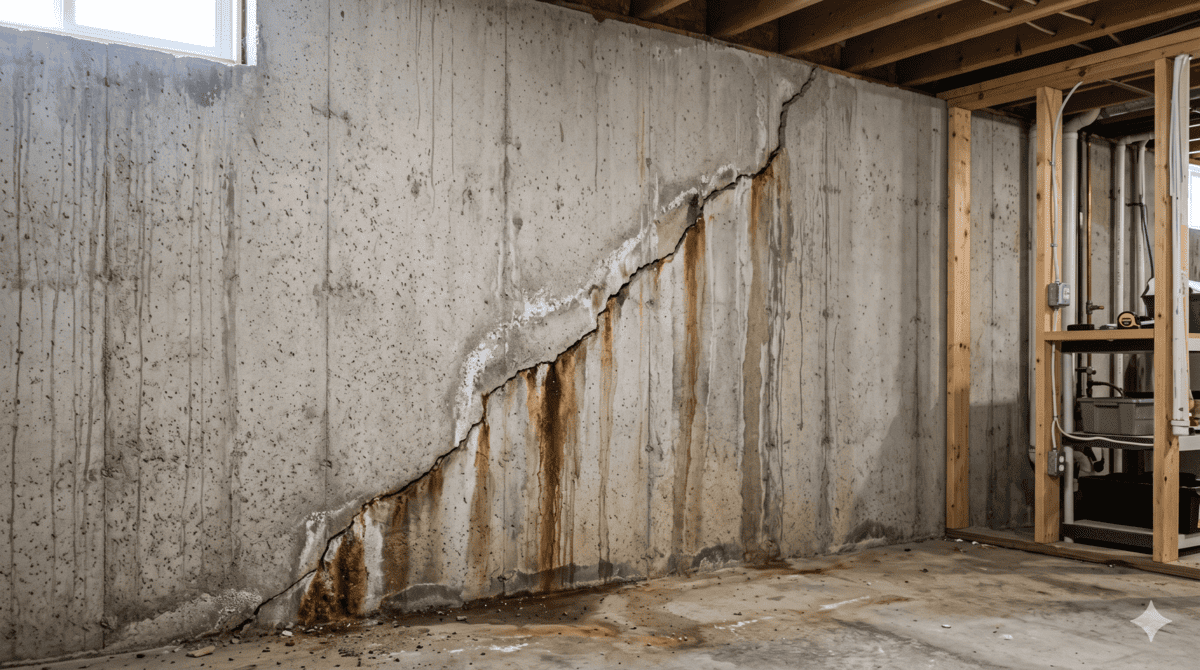
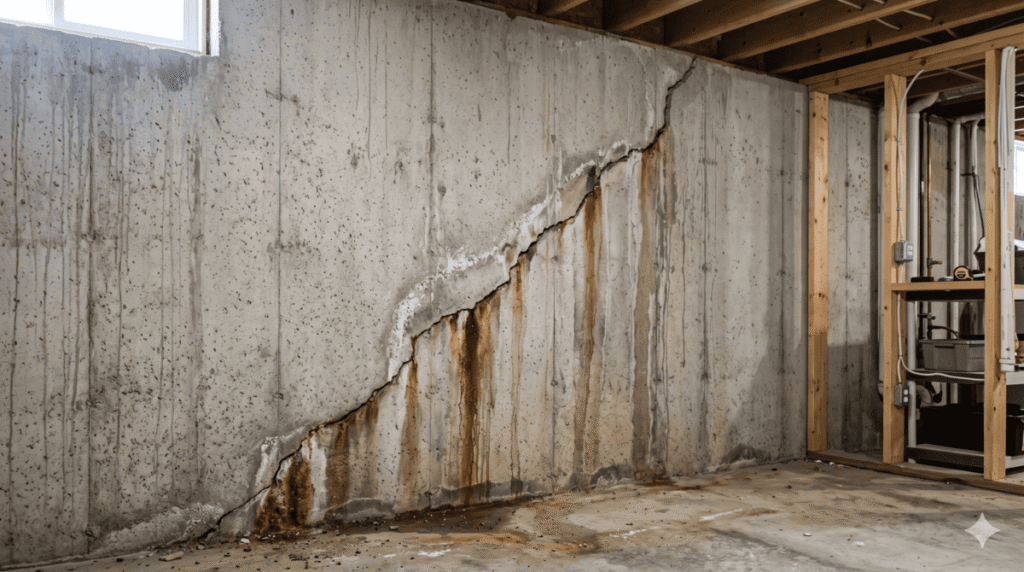
You’re walking through your basement when you notice it – a crack in the foundation wall. Maybe it’s been there for a while. Maybe it appeared after last winter. Either way, your stomach drops, and the questions start: Is this serious? Do I need an engineer? How much is this going to cost me?
The answer depends entirely on the type of crack, its location, its direction, and how it’s changing over time. Not all basement cracks in Calgary are structural emergencies -but some absolutely are, and the consequences of ignoring the wrong one can be severe.
This guide walks you through exactly how to read what your foundation is telling you, which cracks you can monitor and which demand immediate professional attention, and when calling a structural engineer in Calgary is not just a good idea – it’s the only responsible move.
Why Calgary Homes Are Especially Prone to Foundation Cracks
Before getting into crack types, it helps to understand why foundation cracking is so common in Calgary and throughout Alberta.
Calgary sits on expansive clay soils — a type of soil that swells significantly when wet and shrinks when dry. When you add freeze-thaw cycles across a Calgary winter, where temperatures can swing from +10°C to −30°C within the same week, you have the perfect recipe for foundation movement.
Every year, the ground around your home is expanding, contracting, freezing, and thawing. Your foundation is absorbing those forces continuously. Cracks are often how that stress is released.
This doesn’t make every crack a disaster. But it does mean that cracks in Calgary homes carry context that a general contractor — without structural engineering training — isn’t qualified to evaluate.
The 5 Types of Basement Cracks You Need to Know
1- Hairline Cracks — Usually Cosmetic
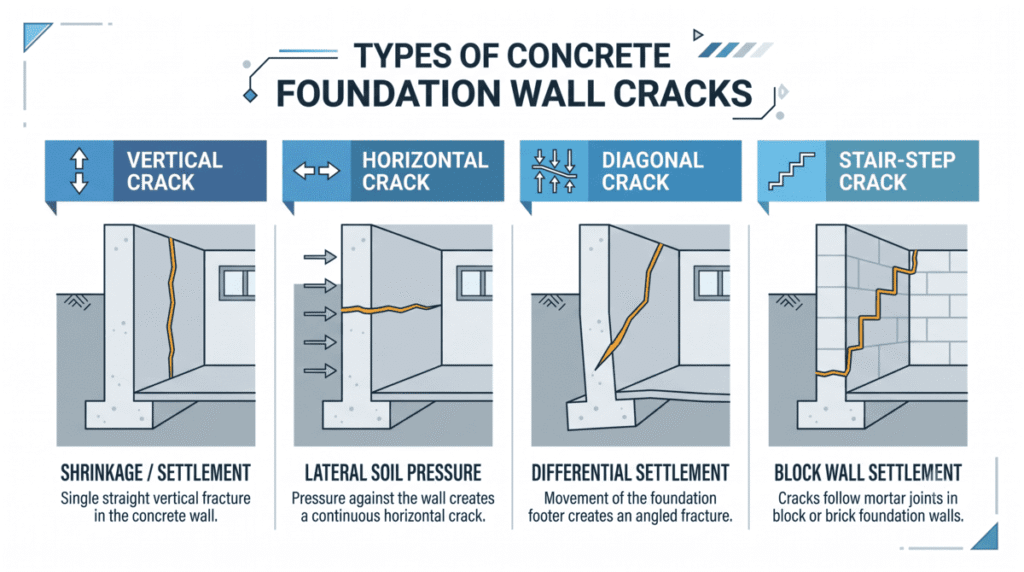
Hairline cracks are thin, surface-level cracks that appear in concrete or mortar as the material cures and dries. They’re extremely common in poured concrete foundations and concrete block walls, and they typically appear within the first few years of a home’s life.
What they look like: Hairline-thin, often less than 0.3 mm wide, no displacement on either side, no moisture seepage.
Are they serious? Usually not. Hairline cracks in poured concrete are typically the result of normal shrinkage during curing, not structural movement. They’re cosmetic in most cases.
What to do: Monitor them. Mark the ends with a pencil and note the date. If the crack grows in length or width over the following months, it’s time to investigate further. If it remains stable and dry, it can usually be sealed with epoxy injection as a moisture precaution.
2- Vertical Cracks — Often Minor, But Worth Watching
Vertical cracks run up and down the foundation wall. They’re one of the most common crack types in Calgary basements, particularly in poured concrete foundations.
What they look like: Running vertically or very slightly diagonal (within 20–30 degrees of vertical), sometimes with minor moisture seepage.
Are they serious? Vertical cracks are generally caused by concrete shrinkage or minor differential settlement – meaning one section of the foundation settled slightly more than the adjacent section. In most cases, they’re not immediately structural.
However, a vertical crack that is wider at the top than the bottom (or vice versa), shows displacement (where one side of the crack sits higher than the other), or is actively leaking water needs professional evaluation. That pattern indicates differential movement, not simple shrinkage.
What to do: Measure the crack width. If it’s under 3 mm, uniform in width, and not leaking, it can often be sealed. If it’s uneven, wider than 3 mm, or shows displacement, get a structural inspection done.
3- Diagonal Cracks — A Signal You Shouldn’t Ignore
Diagonal cracks run at an angle across the foundation wall – typically from a corner of a window or door opening, or from the top of the wall to the base.
What they look like: Running at 30–75 degrees from horizontal, often emanating from structural openings or corners.
Are they serious? Diagonal cracks are more concerning than vertical cracks because they typically indicate differential settlement – where one part of your foundation is moving more than another. This can be caused by soil erosion under one footing, frost heaving, or drainage problems directing water to one section of the foundation.
A single diagonal crack that appeared years ago and hasn’t changed may be a historical settlement crack that stabilized. A new diagonal crack, or one that is actively growing, is a different situation entirely.
What to do: Do not ignore new diagonal cracks or diagonal cracks showing displacement. Mark and date them, and if any change is visible within 30–60 days, contact a structural engineer in Calgary for assessment.
4- Horizontal Cracks — Treat These as an Emergency
Horizontal cracks are the most serious type of basement wall crack. If you find a horizontal crack in your foundation, treat it as a structural emergency until a licensed engineer tells you otherwise.
What they look like: Running horizontally across the wall, often accompanied by inward bowing of the wall surface. They typically appear at or near mid-height of the wall where lateral soil pressure is greatest.
Why are they so serious? Your basement walls are resisting enormous lateral pressure from the soil outside. When the wall is functioning correctly, that pressure is transferred through the structural system. A horizontal crack means the wall is beginning to fail under that lateral load – and once the wall begins to bow inward, the failure can accelerate rapidly.
In Calgary’s expansive clay soils, horizontal cracks can develop more quickly than in other regions because the soil exerts significant lateral pressure when saturated or frozen. A wall with even 1–2 cm of inward bowing is already compromised.
What to do: Call a structural engineer immediately. Do not wait. Do not attempt to waterproof over a horizontal crack. The problem is not moisture – it is structural failure in progress. An engineer will assess the degree of movement, determine whether the wall can be stabilized, and specify the appropriate repair method.
5- Stair-Step Cracks — Context-Dependent but Often Serious
Stair-step cracks appear in concrete block or brick masonry foundations, following the mortar joints in a staircase pattern.
What they look like: Diagonal in direction but stepped, following mortar lines between blocks rather than cutting through them.
Are they serious? Stair-step cracks indicate differential settlement – different sections of the foundation moving at different rates. In concrete block walls, the mortar joint is the weakest point, so settlement-induced movement follows those joints.
The severity depends on how much displacement is visible, whether the crack is growing, and whether any wall section is leaning or bowing. Minor stair-step cracking near corners from historical settlement may be stable. Significant stair-step cracking with visible displacement or an out-of-plumb wall is a structural concern requiring engineering assessment.
The Warning Signs That Make Any Crack More Serious
Regardless of which crack type you’re looking at, these signs escalate the urgency:
Inward bowing or bulging – Any wall section that is no longer plumb (straight vertical) has already moved. This is not a cosmetic issue.
Cracks that are wet or actively leaking – Water intrusion through a crack accelerates deterioration of the concrete and the soil condition outside. It also indicates a breach in the waterproofing membrane.
Cracks wider than 6 mm – A crack of this width has undergone significant movement. It needs to be professionally evaluated regardless of direction.
Multiple cracks appearing at once – A single new crack can result from isolated settlement. Multiple new cracks appearing simultaneously suggest broader foundation movement -a foundation that is shifting under changing soil conditions.
Cracks accompanied by sticking doors or windows -When a foundation moves, the framing of the house moves with it. Doors or windows that suddenly start sticking or binding are a sign that the structure above the foundation is being distorted.
Floors that slope or feel uneven -Significant slope in a basement floor can indicate the slab has settled, heaved, or been pushed by frost or hydrostatic pressure.
If you’re seeing any combination of the above, do not wait. The cost of a structural engineering consultation is a fraction of what delayed action on a failing foundation will cost you.
When Do You Need a Structural Engineer — Not Just a Waterproofing Contractor?
This is one of the most important distinctions Calgary homeowners need to understand.
Waterproofing contractors deal with moisture. They seal cracks, apply membranes, install drainage tile, and sump pumps. That work is legitimate and necessary – but it addresses the symptom of water intrusion, not the cause of structural movement.
A structural engineer evaluates the integrity of the foundation wall as a structural element – its ability to resist the loads being placed on it, and whether it has been compromised.
You need a structural engineer — not just a waterproofing contractor — when:
- Any horizontal crack is present
- The foundation wall is visibly bowing or out of plumb
- Multiple cracks have appeared in a short period
- You’re seeing cracks with visible displacement (one side higher than the other)
- You’re planning any renovation that loads the foundation differently, such as a basement suite, a home addition, or a second storey addition
- You want a structural inspection letter for a real estate transaction
- You need documentation for insurance purposes
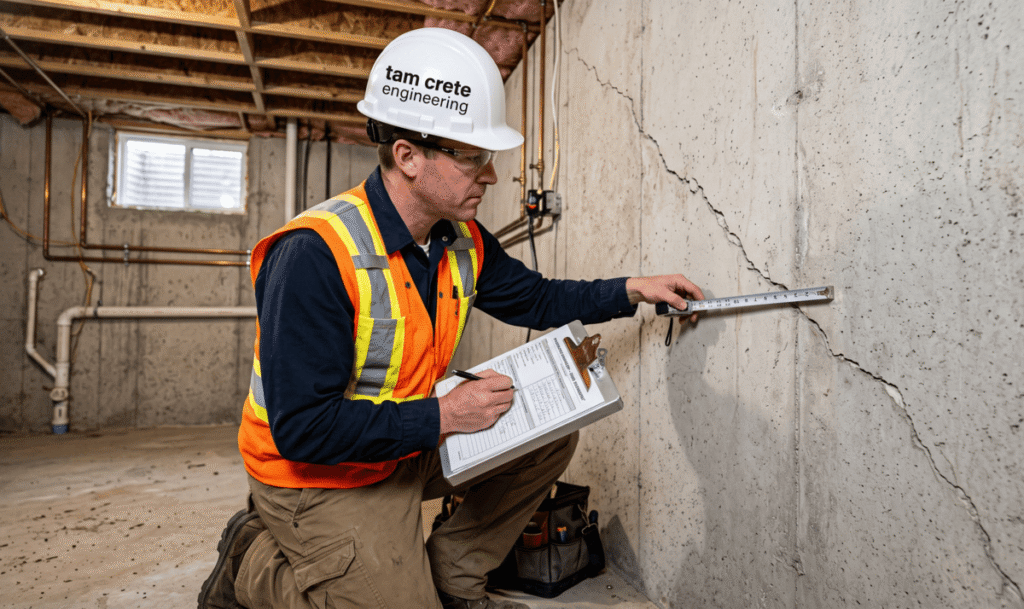
A structural engineer can also provide you with an engineering report or a structural inspection letter — a formal, stamped document that confirms the structural status of the foundation. This is increasingly required by:
- Home buyers conducting due diligence before purchase
- Insurance companies requiring proof of structural assessment
- Mortgage lenders flagging foundation issues during appraisal
- The City of Calgary when issuing permits for basement renovations in homes with known foundation issues
What a Structural Engineering Assessment of Your Foundation Involves
When Tam-Crete Engineering carries out a foundation crack assessment in Calgary, the process is methodical and thorough:
Visual inspection of all accessible foundation walls — We examine all crack locations, directions, widths, and displacement. We note evidence of water intrusion, efflorescence (white mineral deposits indicating water movement through the wall), and any previous repair attempts.
Plumb and level assessment — We check whether walls are bowing inward, and to what degree. Even a few millimetres of movement is documented.
Above-grade review — We look at how the foundation connects to the structure above — floor framing, beam pockets, rim joists, and sill plates — to assess whether foundation movement has transmitted distortion to the above-grade structure.
Site drainage assessment — We review grading, downspout discharge, and surface drainage patterns that may be directing water toward the foundation.
Engineering report or stamped inspection letter — Depending on your need, we can produce either a formal engineering report with findings and recommendations, or a structural inspection letter for real estate, insurance, or permit purposes.
Our team,led by a licensed P.Eng structural engineer serves homeowners and contractors throughout Calgary, Airdrie, Cochrane, Okotoks, Red Deer, Edmonton, and throughout Alberta.
Foundation Crack Repair: What Are the Options?
Once a structural engineer has assessed the crack and determined its cause and severity, repair options may include:
Epoxy injection — Used for non-structural hairline cracks to seal against moisture. Not appropriate for active structural cracks.
Polyurethane foam injection — Flexible sealant that accommodates minor ongoing movement. Used for waterproofing vertical cracks with minor seepage.
Carbon fibre strap reinforcement — For walls with early-stage horizontal cracking or minor bowing, carbon fibre straps bonded to the wall can halt further movement without excavation.
Steel I-beam wall anchors — For more significant horizontal cracking and wall bowing, steel I-beams (wall anchors) are installed vertically against the interior face of the wall to resist further inward movement.
Excavation and external repair — For severely damaged walls or failed waterproofing membranes, external excavation may be required to repair the wall from the outside and apply new waterproofing.
Foundation underpinning — In cases where the foundation footing itself has settled or is bearing on compromised soil, underpinning may be required to re-establish bearing capacity.
The right repair approach depends entirely on what the structural assessment reveals. This is why getting engineering input before contracting any repair work is essential — the wrong repair for the wrong problem wastes money and may mask deterioration that continues underneath.
How to Monitor a Crack While You Wait for an Assessment
If you’re waiting for an engineering assessment and want to track a crack in the interim, here’s a simple protocol:
- Take clear photographs — Get close-up photos with a coin or tape measure in frame for scale.
- Mark the crack ends — Use a pencil to mark the exact end points of the crack and write the date.
- Measure the width — Use a crack gauge, or a ruler held perpendicular to the crack at its widest point.
- Check weekly — A crack that grows in length or width within days is a more urgent signal than one that remains stable over months.
- Note any moisture — Record whether the crack is dry, damp, or actively seeping after rain events.
This documentation is genuinely helpful when your engineer arrives — it gives them information about the rate of change that a single inspection visit cannot provide.
Ready to Move Forward? Let’s Make It Simple.
If you’ve found a crack in your foundation — or you want peace of mind before buying or renovating a Calgary home — Tam-Crete Engineering is ready to help you get the right answers, from a licensed engineer who stands behind them.
Whether you need a structural inspection letter, a full engineering consultation, or stamped drawings for a basement renovation permit, our team works with Calgary homeowners to deliver clear, professional engineering support — without the runaround.
📧 Email us: info@tamcrete-eng.com
Frequently Asked Questions
Are all foundation cracks in Calgary homes serious?
No — not all foundation cracks require immediate action. Hairline shrinkage cracks in poured concrete are extremely common and are usually cosmetic. The type, direction, width, and rate of change are what determine severity. Horizontal cracks, cracks with visible displacement, or cracks that are actively growing are always serious and require a structural engineer’s assessment.
How do I know if a basement crack is structural or just cosmetic?
The most reliable indicators of a structural crack are: the crack runs horizontally, the wall is bowing inward, there is visible displacement (one side of the crack is higher than the other), the crack is wider than 6 mm, or multiple cracks have appeared at the same time. A licensed structural engineer is the only professional qualified to make this determination with certainty.
Can a waterproofing contractor fix a structural crack in my Calgary basement?
A waterproofing contractor can seal a crack against moisture, but sealing a crack is not the same as addressing a structural problem. If the wall is bowing, cracked horizontally, or settling, the underlying structural failure will continue underneath the sealant. A structural engineer must assess and specify the appropriate structural repair before waterproofing work is meaningful.
How much does a structural foundation inspection cost in Calgary?
The cost of a structural engineering assessment in Calgary depends on the scope of the inspection and what documentation is required. For residential foundation inspections with a stamped inspection letter, fees typically range from a few hundred to over a thousand dollars depending on complexity. Contact Tam-Crete Engineering directly at (403) 910-9488 for a project-specific quote.
Do I need a structural engineer’s report to sell my Calgary home if it has foundation cracks?
While Alberta law does not automatically require a structural engineering report before listing a home, sellers are obligated to disclose known material defects — and foundation cracks are a material defect. Buyers increasingly request structural inspection letters before finalizing a purchase, and mortgage lenders may require one if cracks are flagged during a home inspection. A Tam-Crete structural inspection letter provides a stamped, professional assessment that protects both parties.